

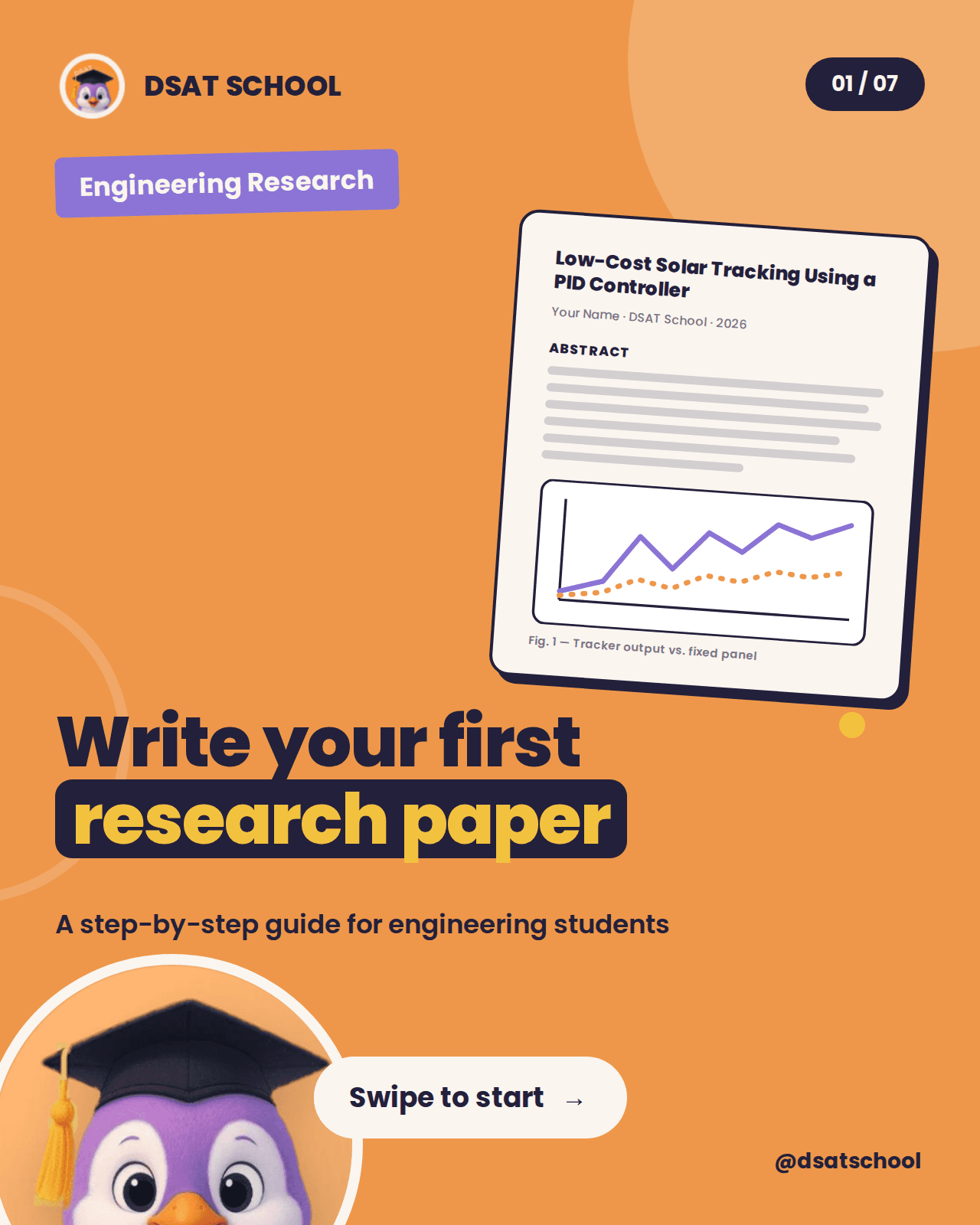
Publish your first Engineering Research Paper

Your First Engineering Research Paper: Where to Actually Begin
In our last carousel, we walked through the anatomy of a research paper, the six steps from idea to submission, the tools researchers use, and the mistakes that get papers rejected. Many of you asked a fair follow-up question: "That's the map, but how do I take the first step?" This article is our answer.
Start smaller than you think
Most first-time researchers fail before they begin, because they pick a topic the size of a textbook. "Renewable energy" is a field. "Improving solar panel efficiency" is still a career. "How does dust accumulation affect the output of a rooftop solar panel in Dhaka's dry season?" is a paper. A good first topic is narrow, measurable, and close to something you can observe, simulate, or get data for. If you can't describe it in one sentence, keep narrowing.
Read like a researcher, not a student
When we suggested reading 15–20 papers, we didn't mean reading each one cover to cover. Start with the abstract and conclusion. If it's relevant, look at the figures, then the method. Keep notes in Zotero on two things: what each paper found, and what it didn't do. That second column is where your research gap lives. When you notice the same limitation mentioned in three papers, you've probably found your question.
Let the tools do the heavy lifting
Engineering research today is largely computational. You don't need a lab to begin; MATLAB or Python lets you model a circuit, simulate a control system, or analyse a public dataset from your laptop. Pick one tool and learn it well enough to produce a clean graph. A single well-made figure that answers your question is worth more than ten pages of explanation.
Write as you go, not at the end
The biggest myth is that writing comes last. Draft your method section while you're running your experiments, because that's when the details are fresh. Write your results paragraph the day you make the graph. By the time your analysis is finished, most of your paper should already exist in rough form, and the final step becomes editing rather than starting from a blank page.
Find someone to check your work
Every published researcher has had a supervisor, co-author, or reviewer catch something they missed. As a first-timer, a mentor's feedback on your question and method can save you months of work in the wrong direction. Ask early, before you've invested too much in an idea that won't hold up.
The honest truth
Your first paper won't be perfect, and it doesn't need to be. Its real value is that it teaches you how research works, from question to evidence to argument. That skill carries into university applications, scholarships, and every project that follows.
If you'd like guided support, our course Fundamental Research with MATLAB & Python, taught by Jahid Hasan (Research Intern at ASI Lab, Norway), walks you through this entire process with hands-on practice.
📞 01766966772 | 🌐 dsatschool.com